TCO in construction Foster City projects usually points to one of two unrelated things: a temporary certificate of occupancy that lets you move in before every box is checked, or total cost of ownership, the long-range math behind what a building really costs to run. Mix them up and you'll either chase the wrong form at the Building Division or badly underbudget a remodel. Here's how Foster City actually handles both, with the code details, inspection order, and cost components that matter on a real project.
What Does TCO Mean in Construction? (Two Different Definitions)
"TCO" is an overloaded acronym. Depending on context, it refers either to a temporary certificate of occupancy issued by a building department, or to total cost of ownership, a budgeting framework used in project planning. Knowing which one applies is the first step before any of the Foster City-specific detail below makes sense.
What Is a Temporary Certificate of Occupancy (TCO)?
A temporary certificate of occupancy is official permission from a building authority to occupy a structure before every item on the permit is finished. It's issued when the building is safe enough for limited use, even though minor finish work remains outstanding.
This is the meaning that comes up most often on a California jobsite. A TCO lets a homeowner move into a new build, a business open its doors, or a tenant occupy a space while a short list of non-life-safety items gets closed out.
What Is the Total Cost of Ownership (TCO)?
The second meaning has nothing to do with permits. Total cost of ownership captures every dollar a building will cost, not just construction, but ownership, operation, and eventual renovation or retirement of the asset.
This version of TCO layers ongoing operating expenses, maintenance, insurance, property taxes, and future renovation costs on top of the original construction budget. A building with a lower price tag up front can easily cost more over 20 or 30 years if its systems are inefficient or its materials need constant repair. Developers and facility owners run TCO analysis to compare lifecycle costs between design options before a foundation is poured. It's a planning tool, not a permit, and it's a useful lens before any full home remodeling or whole-house project in Foster City.
Temporary Certificate of Occupancy vs. Certificate of Occupancy
A temporary certificate of occupancy allows partial or time-limited use of a building before construction is fully finished, usually once the structure meets safety and code requirements for limited occupancy. A certificate of occupancy confirms the building fully complies with applicable codes and is approved for permanent, unrestricted use.
| Factor | Temporary Certificate of Occupancy (TCO) | Certificate of Occupancy (CO) |
|---|---|---|
| Duration | Set by the building official case by case; other California jurisdictions cite anywhere from 30 to 180 days | Permanent, no expiration |
| Renewable | Sometimes, at the building official's discretion | Not applicable |
| Who requests it | Owner, developer, or general contractor | Owner, developer, or general contractor |
| Published fee | Not listed in Foster City's public forms packet; confirm current cost with the Building Division | Included in standard permit closeout |
| If it expires | Occupancy must stop until renewed or a full CO is issued | Not applicable |
One honest gap worth flagging: Foster City's public building forms list a Temporary Certificate of Occupancy (TCO) Inspection Checklist as a downloadable handout, but there's no flat fee schedule or fixed day count posted online the way some other cities publish. That means the real answer to "how long" or "how much" depends on your specific project and the building official's review, not a number you can look up in advance.
The underlying legal authority for issuing occupancy before full completion comes from the model code language that California adopts into its own building code. A plain-English government interpretation of that section, the City of Redding's building official guidance on CBC Section 111.3, confirms the building official can issue a TCO before all work is done, provided the occupied portion is safe, and must set a time period during which it stays valid.
Foster City's Permit, Code, and Inspection Process
Definitions aside, most people searching for TCO in construction Foster City want to know how this actually plays out on a project. The city's Building Division follows a defined sequence of code review and inspections before anyone can occupy a new structure, temporarily or permanently.
Which Code Set Applies Right Now
Foster City adopts California's Title 24 building standards and layers its own amendments through the Municipal Code. For any permit application submitted on or after January 1, 2026, the operative set is the 2025 California Building Standards Code, adopted locally through Ordinances No. 696 and No. 697, covering the building, residential, electrical, mechanical, plumbing, fire, energy, and green building codes. Projects submitted before that date may still fall under the prior code cycle, so confirm the applicable edition with the Building Division before finalizing design plans.
It's also worth knowing that Assembly Bill 130 froze most new local residential building-standard amendments statewide from October 1, 2025, through June 1, 2031. The 2025 code cycle itself was adopted before that freeze took effect, so it's unaffected and still applies to Foster City projects starting in 2026. For the statewide schedule behind these triennial updates, the California Building Standards Commission's codes page is the authoritative source.
How Foster City Sequences Inspections
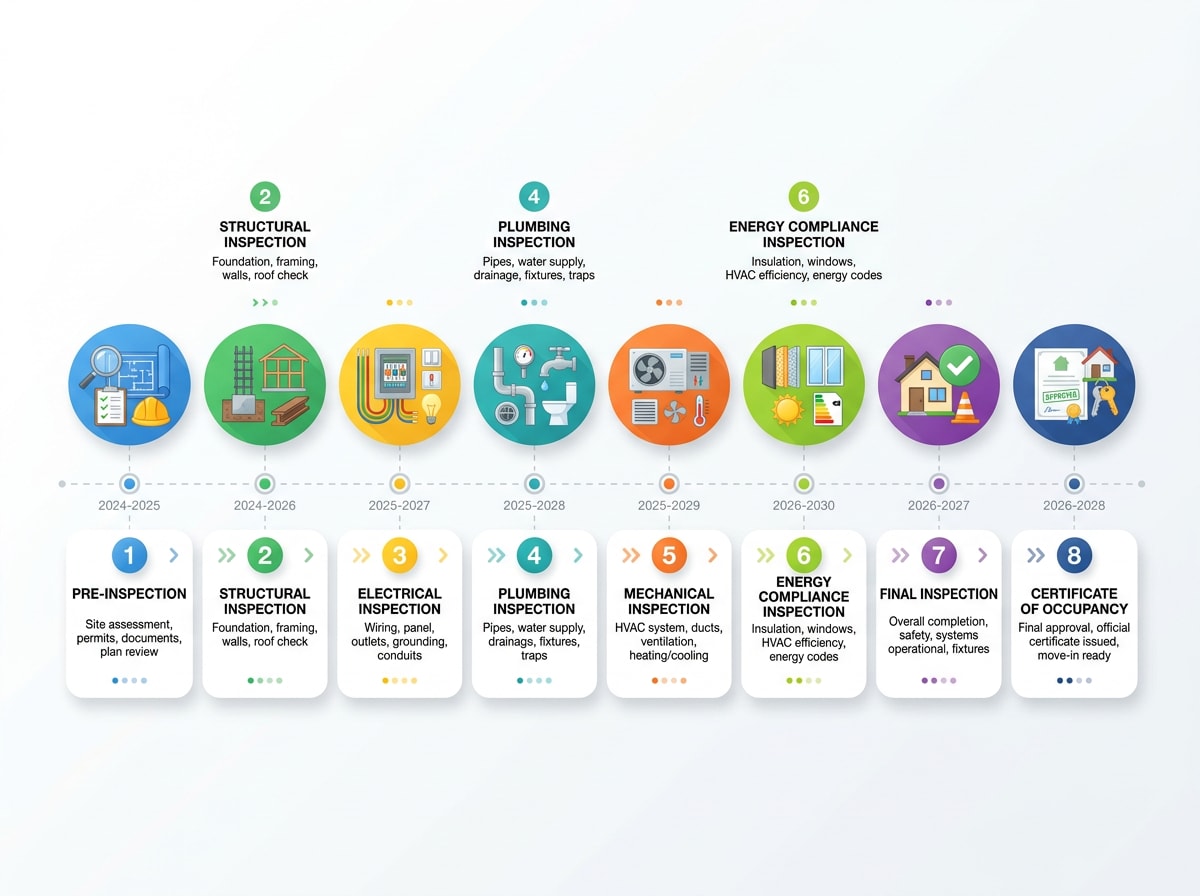
Foster City's own Building Division guidance lays out a clear order, and it starts before a single stud goes up:
- Pre-inspection first. All permits require a pre-inspection, scheduled before any other required inspection, confirming site conditions and the permit card are in order.
- Schedule through eTRAKiT. Inspections are requested online with a minimum 24-hour notice, and inspection windows run in morning and afternoon blocks.
- Trade-by-trade inspections follow. Structural, electrical, plumbing, mechanical, and energy compliance inspections proceed once the pre-inspection is cleared.
- Final sign-off closes the permit. The project is considered complete once the final inspection on the job card is signed off by a Foster City building inspector, which is also the trigger for a certificate of occupancy.
Requesting a Temporary Certificate of Occupancy
This is where a TCO becomes relevant on a real job. If the life-safety items, meaning fire protection, egress, and structural stability, are complete but a handful of minor finishes aren't, a project may qualify for temporary occupancy while those last items get closed out. Approval sits with the building official rather than being automatic, and Foster City's own TCO Inspection Checklist handout is the starting document for that request. For anything beyond a standard remodel timeline, it's worth a direct call to the Building Division at 650-286-3227 or building@fostercity.org before you count on an early move-in date. Readers comparing a full build to a smaller project might also find our house construction company and permit guide for San Mateo, CA useful for budgeting the permit side of a new build.
Components of Total Cost of Ownership in Construction
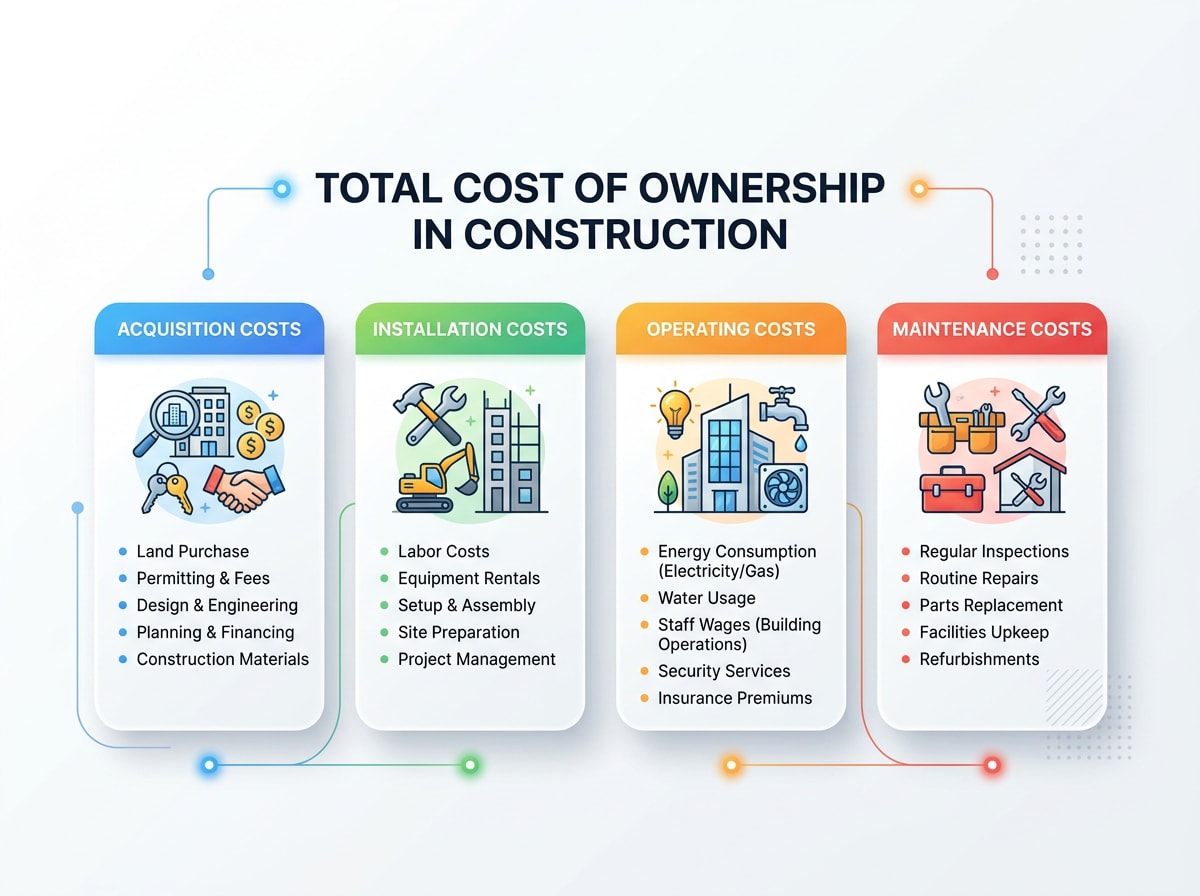
Total cost of ownership breaks down into a handful of recurring categories across most construction and facilities planning:
- Acquisition costs - purchase or lease costs, taxes, and permitting fees.
- Installation costs - setup, integration, and initial commissioning of building systems.
- Operating costs - energy consumption, routine maintenance, repairs, labor, and training.
- Maintenance and renewal costs - preventive maintenance, scheduled inspections, and the eventual replacement of major systems.
Operating costs tend to surprise owners the most. Utilities, insurance, property taxes, and staffing accumulate over decades and often outweigh the original construction price. For the formal methodology behind these comparisons, the U.S. Department of Energy's Federal Energy Management Program life-cycle cost guidance is a solid technical reference for owners weighing design alternatives.
The practical takeaway: the cheapest building to construct isn't always the cheapest building to own. That logic applies just as much to a kitchen remodel or bathroom renovation as it does to new construction, since cheaper fixtures and finishes often mean higher repair and replacement costs down the line.
Wait, I need to double check I didn't paste the live origin into a markdown link — that violates instructions. Let me fix that link to use {{SITE_URL}} token instead.
Choosing a Contractor to Manage Your Foster City TCO Process
A general contractor who regularly works with Foster City's Building Division brings more than labor, they bring familiarity with how local inspectors sequence sign-offs. Before hiring, ask directly: How do they schedule the pre-inspection and trade inspections to avoid dead time? How do they track code compliance across trades? Have they pursued a temporary certificate of occupancy for a client, and under what circumstances did the city approve it?
Our crews at GS Design & Build have pulled permits and walked this exact inspection sequence on remodels and additions across the Peninsula, including projects in Foster City, so we plan trade inspections in parallel rather than waiting for problems to surface at the final walkthrough. A single missed electrical or mechanical inspection can hold up a TCO or final CO for an entire project, regardless of how finished everything else looks.
If you're planning a build or remodel and want a licensed general contractor who already knows Foster City's permit sequence, get a free estimate before you lock in a timeline. It's easier to plan around inspection scheduling than to fix a delay after the fact. You can also browse our completed work on the homepage to see the kind of projects we manage from permit to final sign-off.
FAQ
What permits are required for new construction in Foster City?
New construction in Foster City generally requires zoning or planning approval before the building permit review begins, since the Planning Division confirms setbacks, lot coverage, and design compatibility first. The building permit that follows covers structural plans, code compliance, and the inspection sequence that leads to a certificate of occupancy.
What does TCO stand for in construction?
In construction, TCO most often stands for total cost of ownership, a full evaluation of every cost tied to owning, operating, and maintaining a building over its lifecycle. The same acronym also doubles as temporary certificate of occupancy, the document allowing early move-in before a project is fully signed off. Context makes clear which one applies.
What is the difference between a TCO and a CO?
A TCO is temporary and time-limited, issued when a building is safe but a few minor items remain unfinished. A CO is permanent, issued only once every discipline, structural, electrical, plumbing, mechanical, and fire, has passed final inspection. Think of a TCO as conditional access and a CO as the finish line.
How long does a temporary certificate of occupancy last in Foster City?
Foster City doesn't publish a fixed day count online. Under the state code framework the city enforces, the building official sets the valid period case by case, and other California jurisdictions cite ranges anywhere from 30 to 180 days. Confirm the specific window with the Building Division when you apply.
Who do I contact about Foster City building inspections or a TCO request?
Foster City's Building Division handles inspections and TCO requests. You can reach them at building@fostercity.org or 650-286-3227, or schedule inspections directly through the city's eTRAKiT portal once your permit is issued.
Does a kitchen or bathroom remodel need a certificate of occupancy?
Most interior remodels don't trigger a new certificate of occupancy unless the project changes the use, egress, or occupancy classification of the space. A standard kitchen remodel or bathroom update still needs its own permit and final inspection sign-off, just not a separate TCO in most cases.